Executive Resume ATS Optimization: A Practical Guide for Senior Professionals 
For senior professionals and executives, a resume needs to do more than describe years of experience. It needs to communicate leadership, business impact, strategic expertise, and measurable achievements in a format that both recruiters and modern hiring systems can understand.
This is where Executive Resume ATS Optimization becomes important.
Many organizations use Applicant Tracking Systems (ATS) to organize and evaluate resumes before recruiters review them. Even highly experienced executives can miss opportunities when their resumes contain unclear formatting, insufficient keywords, or content that does not closely reflect the requirements of a target position.
What Is Executive Resume ATS Optimization?
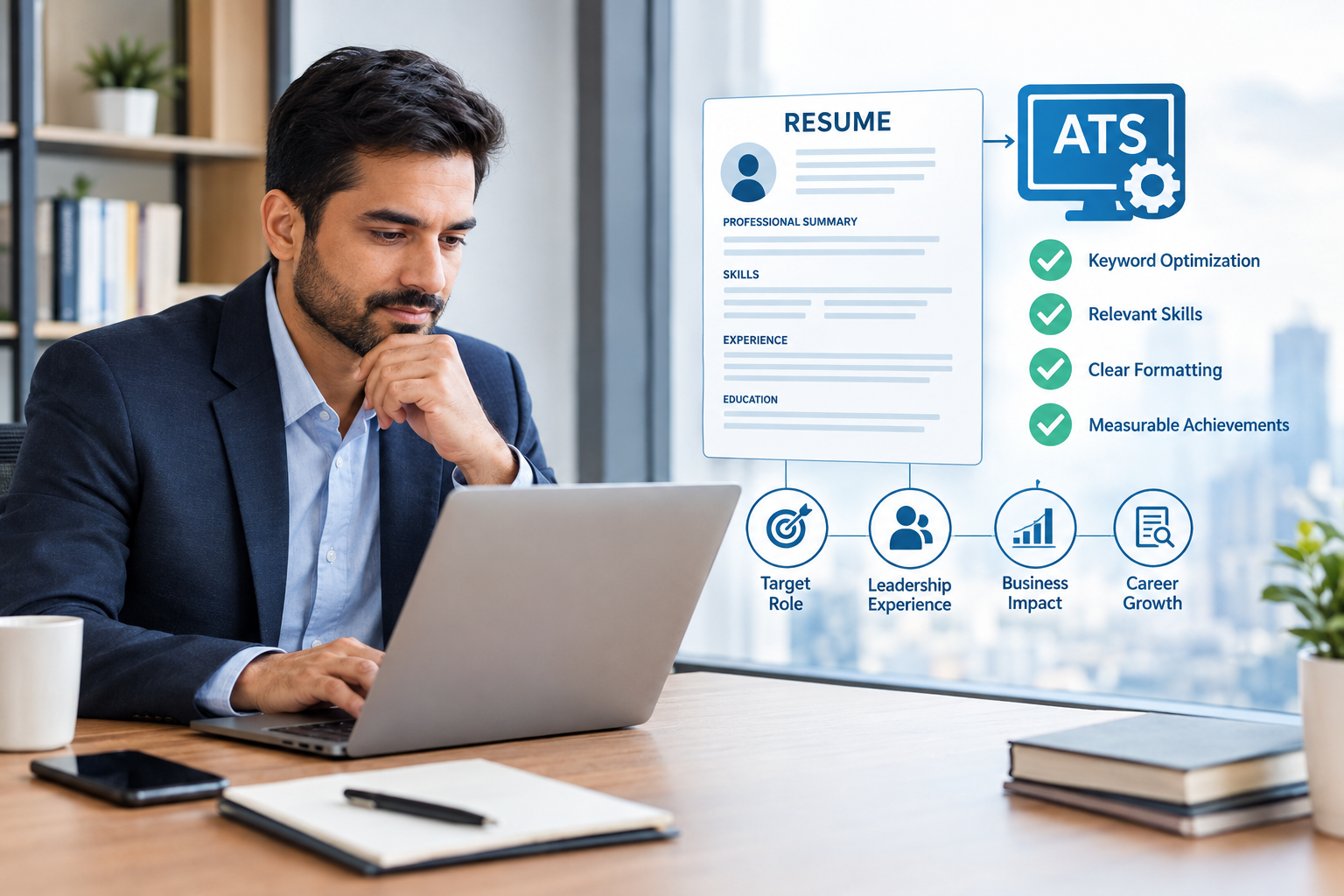
Executive Resume ATS Optimization is the process of improving an executive resume so that it is easier for applicant tracking systems to parse while remaining clear, persuasive, and professional for human recruiters.
An optimized executive resume should communicate several things quickly:
Leadership experience Strategic responsibilities Industry knowledge Technical and professional expertise Business achievements Relevant keywords Career progression Measurable results
The goal is not to fill a resume with keywords. Instead, keywords should be incorporated naturally into meaningful descriptions of responsibilities and accomplishments.
Why ATS Optimization Matters for Executives
Executives often have extensive careers, which can make resume writing more complicated. A professional may have managed teams, launched major initiatives, increased revenue, improved operational efficiency, or led organizational transformation across several companies.
However, simply listing these experiences does not guarantee that the resume will match a particular executive position.
For example, a Chief Operating Officer position may emphasize terms such as operational strategy, organizational transformation, performance management, process improvement, and P&L responsibility. If these concepts are relevant to the candidate's background but are not clearly represented in the resume, the document may have difficulty demonstrating its relevance.
ATS optimization helps bring the most important qualifications forward.
Start With the Target Executive Position
One of the most effective approaches is to optimize the resume around a specific job opportunity rather than creating one generic resume for every application.
Review the job description carefully and identify:
- Required leadership capabilities
- Industry-specific terminology
- Technical or functional skills
- Strategic responsibilities
- Certifications or qualifications
- Frequently repeated phrases
- Expected business outcomes
These terms can then be compared with the candidate's existing experience.
The important point is authenticity. An executive should never add a skill or qualification simply because it appears in a job description. The resume should reflect genuine experience.
Focus on Achievements Instead of Responsibilities
Senior-level resumes become stronger when they demonstrate business impact.
Instead of writing:
Managed a large sales organization and developed sales strategies.
A stronger approach could be:
Led a 40-person sales organization and redesigned regional sales strategies, contributing to a 22% increase in annual revenue.
The second version provides context, scale, leadership, and a measurable result.
For executive professionals, achievement-focused writing can help demonstrate the value they have created throughout their careers.
Use Relevant Executive Keywords Naturally
Keywords are an important part of ATS optimization, but keyword stuffing can make a resume difficult to read.
Consider an executive applying for a technology leadership role. Relevant terminology might include:
- Digital transformation
- Technology strategy
- Enterprise architecture
- Cybersecurity
- Cloud transformation
- IT governance
- Data strategy
- Change management
- Cross-functional leadership
Only include terminology that accurately represents the candidate's background.
A useful approach is to connect keywords with evidence. Instead of simply listing "digital transformation," explain how the candidate led a digital transformation initiative and what business result it produced.
Keep the Resume ATS-Friendly
Formatting can also affect how an ATS interprets resume content.
Executives should generally avoid unnecessary design elements that may interfere with parsing, including excessive graphics, complicated tables, text embedded inside images, and unusual layouts.
A clean structure usually works better:
Executive Summary
A concise overview of leadership experience and professional value.
Core Competencies
Relevant leadership, functional, and industry skills.
Professional Experience
Roles, organizations, responsibilities, and measurable achievements.
Education & Certifications
Relevant academic qualifications and professional credentials.
Simple headings and consistent formatting make the document easier for both software and people to navigate.
Strengthen the Executive Summary
The executive summary is one of the first sections recruiters are likely to review.
Rather than using generic statements such as "results-driven professional with extensive experience," use the opening section to establish professional identity and value.
For example:
Technology executive with 15+ years of experience leading enterprise transformation, technology strategy, and cross-functional teams across global organizations. Proven record of improving operational efficiency, modernizing technology environments, and delivering large-scale digital initiatives.
This type of summary gives recruiters a clearer understanding of the candidate's level, specialization, and potential value.
Include Numbers Whenever Possible
Numbers can make executive accomplishments more credible and easier to understand.
Consider including metrics such as:
- Revenue growth
- Cost savings
- Team size
- Budget responsibility
- Customer growth
- Market expansion
- Productivity improvements
- Project value
- Operational improvements
- Time reductions
For example:
Reduced annual operating costs by 18% through process redesign and technology modernization.
Specific results provide more substance than broad claims such as "improved operational performance."
Match the Resume to Each Opportunity
Executive candidates often apply for positions with different leadership requirements. A resume optimized for a CEO role may not communicate the same priorities as one designed for a COO, CIO, CTO, CFO, or VP-level position.
The professional experience may remain the same, but the emphasis can change.
For example:
- A CFO resume may emphasize financial strategy, forecasting, risk management, and profitability.
- A COO resume may emphasize operations, process improvement, organizational performance, and execution.
- A CTO resume may emphasize technology strategy, innovation, architecture, and digital transformation.
- A CHRO resume may emphasize talent strategy, organizational development, culture, and workforce planning.
This targeted approach makes the resume more relevant to the position.
Review the Resume Before Applying
Before submitting an executive resume, review it from both an ATS and recruiter perspective.
Ask:
- Does the resume clearly identify the executive's area of expertise?
- Are important qualifications from the job description reflected where relevant?
- Are achievements supported by measurable outcomes?
- Is the formatting simple and consistent?
- Can an ATS easily identify the candidate's experience and skills?
- Does the resume communicate leadership impact within the first few sections?
- Are irrelevant details taking attention away from more important accomplishments?
An ATS resume scanner or resume analysis tool can provide an additional perspective by identifying potential keyword gaps, formatting issues, and areas where the resume could better align with a particular job description.
Avoid Over-Optimizing the Resume
Optimization should improve a resume, not make it unnatural.
An executive resume filled with repeated keywords can feel robotic and may make it harder for recruiters to understand the candidate's actual achievements.
The best approach is balance:
ATS compatibility + relevant keywords + clear storytelling + measurable achievements.
Your resume should still sound like a professional executive wrote it.
How AI Can Support Executive Resume Optimization
AI-powered resume tools can help candidates compare their resumes with job descriptions and identify areas that may need attention.
For example, an AI-based analysis may highlight:
- Missing relevant keywords
- Skills that are not clearly demonstrated
- Sections that could be more concise
- Potential formatting concerns
- Opportunities to strengthen achievements
- Areas where the resume could better reflect the target position
Tools such as Resume Match Me can be useful as part of this review process, particularly when candidates want structured feedback before submitting an application.
However, AI should support professional judgment rather than replace it. Executives should always review suggested changes and ensure that the final resume accurately represents their experience.
Final Thoughts
Executive Resume ATS Optimization is about making senior-level experience easier to discover, understand, and evaluate.
A strong executive resume combines relevant keywords with compelling leadership achievements, measurable results, clear formatting, and a focused professional narrative. Instead of trying to impress an ATS with excessive keywords, the goal should be to create a resume that successfully communicates genuine qualifications to both technology and human decision-makers.
For executives competing for senior-level opportunities, taking time to review and optimize a resume before applying can make the application more focused, relevant, and easier to evaluate.
Additional Career Resources:
For regular updates on resume optimization, interview preparation, AI resume builder, follow our LinkedIn profile.
