Cloud Security Services Company: What Businesses Should Look For in a Security Partner 
As more critical workloads move to the cloud, attackers follow. IBM’s 2025 Cost of a Data Breach Report put the global average breach cost at $4.44 million. About 30% of breaches involved data spread across multiple environments, and those took 276 days to identify and contain, well above the 217 days for on-premises incidents. For businesses, the lesson is clear: security must be designed into the cloud, not added later. That is why the strongest security partners combine protection with proven cloud engineering services. This guide explains what to look for.
Why Cloud Security Needs a Specialist Partner 
Whether you work with a cloud services company or a dedicated security firm, the partner must understand how cloud environments are built, not only how they are attacked. Misconfigured access, unmanaged workloads, and fragmented tooling create gaps that generic security providers often miss.
- Security by design: controls are part of the architecture from day one.
- Consistency at scale: automated, repeatable configurations reduce human error.
- Faster response: teams that know your environment contain incidents sooner.
Also read: How to Choose a Cloud Security Services Company in India in 2026 
Cloud Security by the Numbers: Data and Figures 
IBM’s 2025 research highlights where the risks and rewards lie.
- $4.44 million: global average cost of a data breach, down 9% from $4.88 million in 2024.
- 241 days: average time to identify and contain a breach, a nine-year low.
- 30%: share of breaches involving data distributed across public cloud, private cloud, and on-premises environments.
- 276 days vs. 217 days: containment time for multi-environment breaches versus on-premises breaches.
- $1.9 million: average savings for organizations using AI and automation extensively in security operations, along with breaches resolved 80 days faster.
- 97%: share of organizations with AI-related breaches that lacked proper AI access controls.
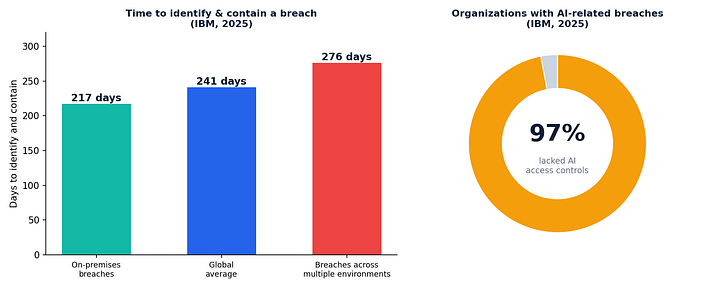 Breach containment times and AI access control gaps
The pattern is consistent: complexity slows detection, while automation and strong governance reduce both cost and damage.
For enterprises, this means evaluating partners on measurable capabilities rather than brand names, and testing those capabilities before signing a long-term agreement.
What to Look For in a Cloud Security Partner 
1. Depth in Cloud Engineering Services 
Choose a provider that can design, build, and operate cloud infrastructure securely. Infrastructure as code, hardened configurations, and identity-first architecture reduce risk far more reliably than after-the-fact patching.
2. Experience With Enterprise Cloud Solutions 
Large organizations rarely use a single platform. Look for proven experience across AWS, Azure, and Google Cloud, plus hybrid and multi-cloud environments, since that is where visibility gaps appear.
3. Strong Cloud Consulting Services 
- Risk assessments: a clear view of exposures across identity, data, and workloads.
- Architecture reviews: practical recommendations, not generic checklists.
- Roadmaps: prioritized actions linked to business risk and budget.
Good cloud consulting services turn findings into a plan your team can execute, and IT strategy consulting ensures that plan supports wider business goals, budgets, and risk appetite.
4. Secure Cloud Development Services 
If you build applications in the cloud, your partner should offer cloud development services that embed security testing in every release. DevSecOps practices such as automated code scanning, container checks, and secrets management catch vulnerabilities before they reach production. Cloud DevOps consulting can also help your teams adopt these habits without slowing delivery.
5. 24/7 Monitoring and Incident Response 
Threats do not keep business hours. Because breach costs grow with dwell time, speed matters. Confirm that the provider runs a round-the-clock security operations center with defined response times, clear escalation paths, and tested playbooks.
6. Compliance, Governance, and AI Security 
- Frameworks: ISO 27001, SOC 2, and industry or regional regulations.
- Audit readiness: evidence collection and reporting built into operations.
- AI governance: access controls and monitoring for AI workloads and shadow AI.
7. Transparent Contracts and Clear Metrics 
Insist on defined service levels, reporting cadence, and exit terms. A trustworthy partner shares metrics such as detection time, response time, and remediation rates.
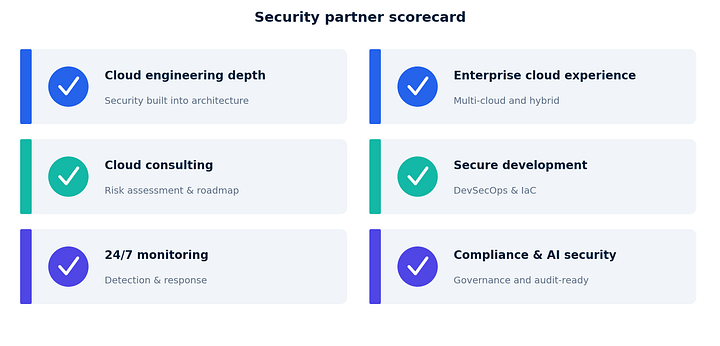 A six-point scorecard for evaluating cloud security partners
Layers of Protection to Expect 
A capable partner protects every layer, from governance to monitoring, rather than selling a single tool. Overlapping layers matter because attackers look for the weakest one, and a gap in identity or monitoring can undermine otherwise strong controls.
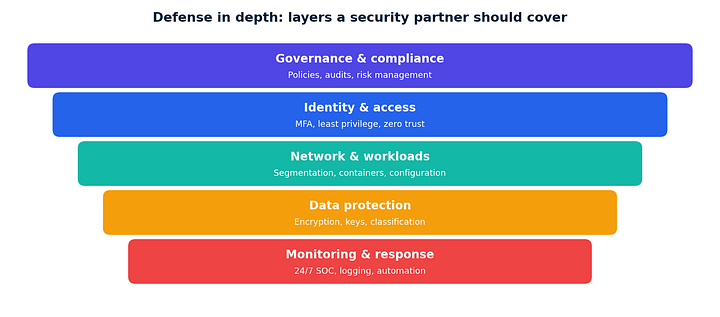 Defense in depth across the cloud environment
Use the scorecard above to compare shortlisted providers consistently, and ask each for customer references and evidence of results in environments similar to yours.
Red Flags to Avoid 
- Tool resale only, with no engineering or response capability.
- One-size-fits-all packages that ignore your architecture.
- No certifications or reluctance to share audit reports.
- Vague incident response terms and unclear escalation.
- Proprietary lock-in that makes leaving costly.
Also read: How Cloud Security Services Protect Enterprise Data and Infrastructure 
Conclusion 
Choosing a cloud security partner is a decision about resilience, not just tools. The best providers unite security expertise with cloud engineering services, practical consulting, and secure development, so protection is built into every layer. Evaluate partners on evidence, pilot before committing, and select the team that treats your risk as its own.
FAQs 
1. What does a cloud security services company do? 
A cloud security services company helps businesses protect cloud infrastructure, applications, data, identities, and workloads. Services may include security assessments, threat monitoring, compliance, identity management, vulnerability management, and incident response.
2. Why should businesses work with a cloud security services company? 
A specialist can identify cloud-specific risks, strengthen security controls, improve threat detection, and help businesses manage complex or multi-cloud environments. It can also provide expertise that may be difficult to maintain with an in-house team alone.
3. How do I choose the right cloud security services company? 
Look for experience with your cloud platforms, strong security and cloud engineering capabilities, relevant certifications, clear incident response processes, compliance expertise, transparent pricing, and measurable service-level agreements.
4. What cloud security services should a business look for? 
Common services include cloud security assessments, identity and access management, vulnerability management, security monitoring, threat detection, incident response, compliance support, data protection, DevSecOps, and cloud security architecture.
5. How much do cloud security services cost? 
The cost depends on factors such as cloud environment size, number of workloads, security requirements, compliance needs, monitoring coverage, and engagement model. Businesses should request a customized assessment rather than relying on a standard price.
6. Can a cloud security company secure multi-cloud environments? 
Yes. Experienced providers can help secure environments across AWS, Microsoft Azure, Google Cloud, private clouds, and on-premises infrastructure. The key is maintaining consistent security policies and visibility across all environments.
.svg)